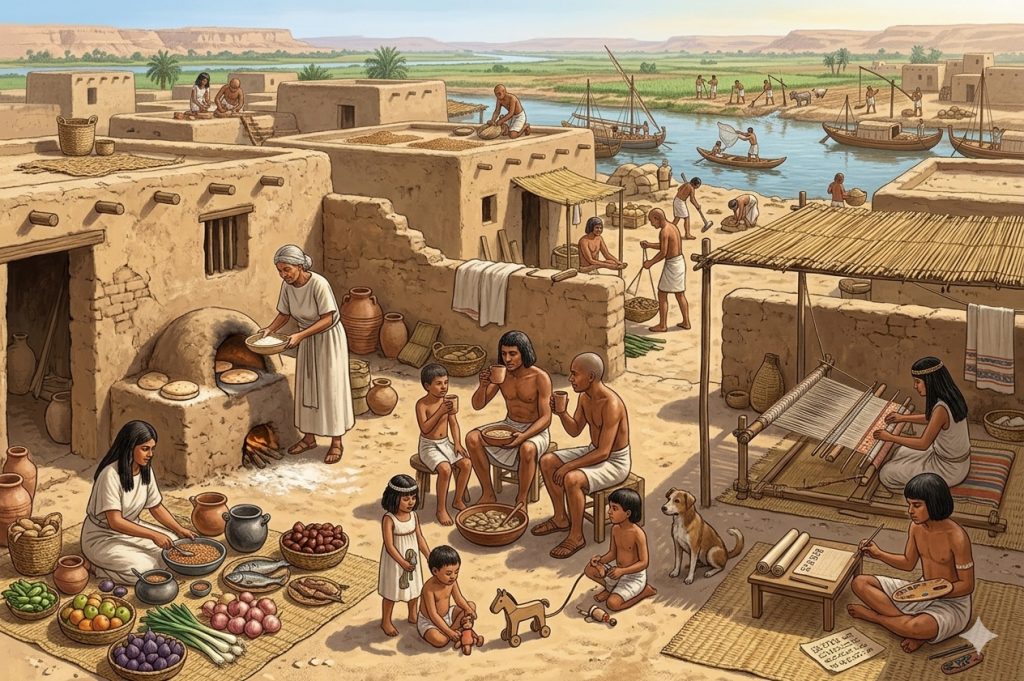
When people think about ancient Egypt, they often picture pyramids, pharaohs and monumental temples. But ancient Egyptian civilization was also built by farmers, craftsmen, workers, scribes, merchants and families whose everyday lives can still be studied through archaeological evidence.
Ancient Egyptian daily life was closely connected to the Nile, agriculture, skilled craftsmanship and the organization of communities. Tomb paintings, archaeological settlements, tools, inscriptions and preserved objects provide valuable evidence about how people lived and worked.
One of the best places to explore this side of ancient Egypt is Luxor, particularly the archaeological site of Deir el-Medina, where a community of workers and craftsmen lived while working on royal tombs.
What Was Daily Life Like in Ancient Egypt?
Daily life varied considerably depending on a person’s occupation, social position, location and historical period.
A farmer’s daily routine was very different from that of a royal official or a craftsman working in a royal necropolis. For this reason, there was no single “typical” ancient Egyptian lifestyle.
Archaeologists reconstruct aspects of everyday life by comparing different types of evidence, including:
- Houses and settlements
- Tomb paintings and reliefs
- Tools and household objects
- Written documents and inscriptions
- Food remains and agricultural evidence
- Tombs and funerary equipment
Together, these sources provide a more detailed picture of ancient Egyptian society.
Food & Agriculture
Agriculture was fundamental to life along the Nile.
The annual flooding of the Nile supported agricultural production, while crops such as wheat and barley played an important role in the ancient Egyptian economy and diet. Other foods included vegetables, fruits, fish and various animal products.
Tomb paintings and reliefs frequently depict agricultural activities such as plowing, sowing, harvesting, fishing and food preparation.
These scenes are especially useful when studying how agriculture was represented in ancient Egyptian society, although they should be interpreted within their funerary context rather than treated as simple photographs of everyday life.
Work & Occupations
Ancient Egyptian society depended on a wide range of occupations.
Farmers worked the land, while craftsmen produced pottery, textiles, tools, jewelry and other goods. Scribes and administrators performed important roles in managing institutions and recording information.
In Luxor, Deir el-Medina provides an unusually detailed archaeological window into the lives of a specialized community.
The settlement was occupied by workers and craftsmen associated with the construction and decoration of royal tombs in the Theban necropolis. Archaeological remains from the site include houses, tombs, inscriptions and other evidence connected with the community.
This makes Deir el-Medina particularly valuable for travelers interested in the people behind the monumental tombs of ancient Egypt.
👉 Explore Deir el-Medina and the lives of the royal tomb workers on our Ancient Egyptian Daily Life & Culture Tour in Luxor.
Homes & Family Life
Archaeological remains from settlements such as Deir el-Medina help researchers understand aspects of domestic life.
The remains of houses can reveal information about the organization of living spaces and the material culture of households.
Objects recovered from settlements and tombs can also provide clues about cooking, storage, personal belongings, crafts and other activities.
Family relationships are also reflected in ancient Egyptian inscriptions and funerary monuments, although the evidence varies between periods and social groups.
Clothing & Appearance
Ancient Egyptian clothing was influenced by climate, social position, occupation and cultural traditions.
Linen was an important textile, and representations in tombs and monuments show different forms of clothing and personal adornment.
Jewelry, cosmetics and hairstyles also formed part of ancient Egyptian appearance.
However, artistic representations were often idealized or influenced by the purpose of the monument, so archaeologists compare artistic evidence with surviving objects and textiles whenever possible.
Entertainment, Music & Social Activities
Ancient Egyptian art depicts a variety of activities associated with music, dancing, banquets and social gatherings.
Scenes from private tombs can show musicians, dancers, banquets and recreational activities.
These representations are useful evidence, but they must be understood within the context of tomb decoration and the beliefs of the people who commissioned these monuments.
Deir el-Medina: A Unique Window Into Ancient Life
If you want to understand ancient Egyptian daily life beyond the world of kings and pyramids, Deir el-Medina is one of the most important places to visit in Luxor.
The settlement was connected with the workers who created and decorated royal tombs in the nearby necropolis.
Its archaeological remains provide evidence of:
- Residential life
- Skilled craftsmanship
- Community organization
- Religious practices
- Written records
- Tomb construction
- Family and social relationships
The site is particularly valuable because it combines archaeological remains with written and artistic evidence.
👉 Read more about Deir el-Medina: Life of the Workers Who Built the Royal Tombs.
What Can Ancient Tomb Paintings Tell Us?
Ancient Egyptian tomb decoration provides some of the most recognizable evidence for studying society.
Scenes can depict:
- Farming
- Fishing
- Hunting
- Food production
- Craftsmanship
- Music
- Dancing
- Animals
- Household and social activities
These scenes can help researchers investigate ancient Egyptian life, but they should always be interpreted in relation to the function of the tomb and the beliefs of its owner.
👉 Learn more in our guide to Ancient Egyptian Art: What Tomb Paintings Tell Us.
Why Luxor Is Important for Understanding Daily Life
Luxor was the location of ancient Thebes, one of the most important cities of ancient Egypt.
The East Bank was associated with major temples such as Karnak and Luxor, while the West Bank contains extensive funerary landscapes and settlements.
This concentration of archaeological evidence makes Luxor particularly valuable for understanding different aspects of ancient Egyptian society.
Visitors can compare:
- Royal tombs in the Valley of the Kings
- Private tombs of officials and nobles
- The workers’ settlement at Deir el-Medina
- Major temples on the East Bank
- Archaeological remains across the Theban landscape
Together, these places show that ancient Egyptian civilization was not only about pharaohs and monuments. It was also about the communities and individuals who created, maintained and lived within this society.
Experience Ancient Egyptian Daily Life in Luxor
For travelers who want to explore these subjects directly, our Ancient Egyptian Daily Life & Culture Tour in Luxor focuses on archaeological locations that provide real evidence of ancient Egyptian society.
The experience can include visits to Deir el-Medina, the Tombs of the Nobles and other relevant sites on Luxor’s West Bank, depending on site access and availability.
With a professional Egyptologist guide, the tour connects archaeological remains, tomb decoration and historical evidence to help explain how different groups lived and worked in ancient Egypt.
Frequently Asked Questions
What did ancient Egyptians eat?
Their diet varied by social group and period, but agricultural products such as cereals, vegetables, fruits and fish were important components of ancient Egyptian food culture. Archaeological and artistic evidence provides information about food production and consumption.
Where can I see evidence of ancient Egyptian daily life?
Luxor’s Deir el-Medina is one of the most valuable places for studying daily life because it preserves remains of a workers’ settlement along with tombs and written evidence.
What was Deir el-Medina?
Deir el-Medina was a settlement associated with workers and craftsmen who built and decorated royal tombs in the Theban necropolis.
Do tomb paintings show real everyday life?
They can provide valuable evidence about activities such as agriculture, food production, music and craftsmanship, but they were created for specific funerary purposes and should not be interpreted as straightforward photographs of daily life.
Can I visit Deir el-Medina with an Egyptologist?
Yes. Our Ancient Egyptian Daily Life & Culture Tour in Luxor includes a professional Egyptologist guide to explain the archaeological evidence and historical context.
Is this topic suitable for families?
Yes. Travelers interested in history and archaeology can explore ancient Egyptian daily life through accessible examples such as houses, crafts, food production and tomb paintings.
Explore Ancient Egyptian Culture
Ancient Egyptian civilization becomes easier to understand when we look beyond its most famous monuments.
The houses of Deir el-Medina, agricultural scenes in tombs, surviving objects and archaeological remains all contribute to our understanding of the people who lived in ancient Egypt.
👉 Explore our Ancient Egyptian Culture: History, Daily Life & Heritage guide for a broader introduction to ancient Egyptian culture.
Leave a Reply
You must be logged in to post a comment.